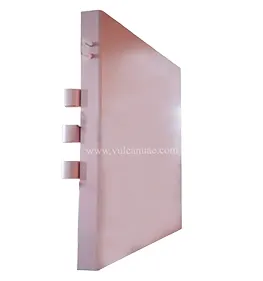
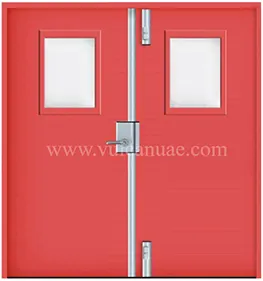
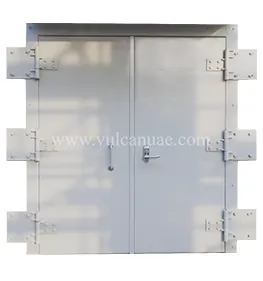
Blast Resistance Doors
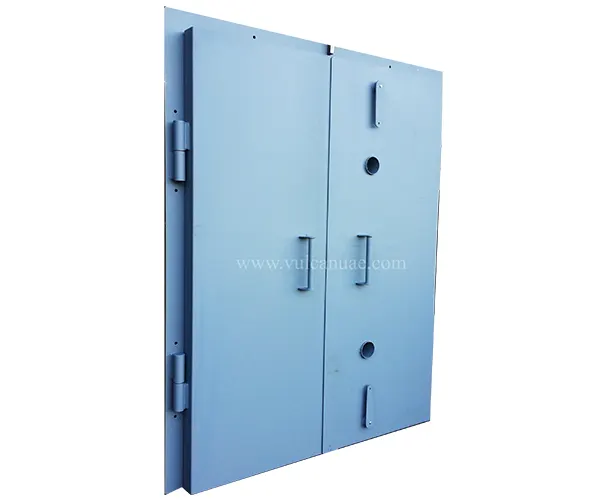
Blast Resistance Doors
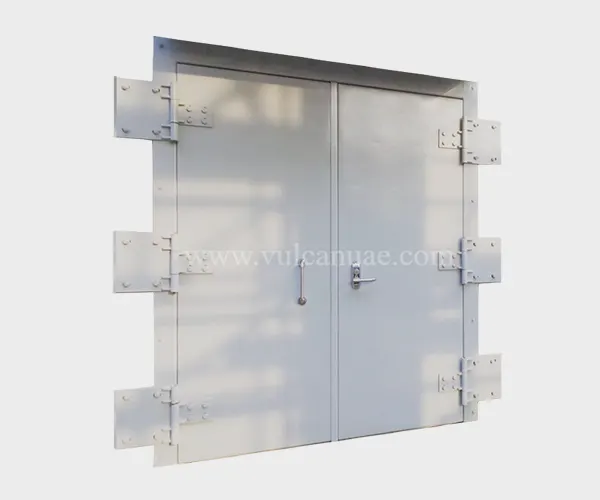
Vulcan Steel Blast Resistance doors are designed to provide essential protection for life, infrastructure, and assets against both intentional and accidental blasts. These doors offer superior resistance to expansion, bending inward to absorb pressure and minimize damage to the building structure. Combining fire-resistant properties with low heat transfer and a high melting point, Vulcan Steel Blast doors effectively mitigate the spread of explosions and mass detonations, safeguarding personnel and valuable equipment.
Features
High Quality Strong GI cladded heavy metal section
High quality strong Metal Door with Reinforcements
High Security Ironmongeries
DNV as per AISCE guidelines – Design of Blast Resistant Buildings in Petrochemical Facilities, Second Edition and AISC – 9thedition, ASTM F2927 air blast loadings.
Each assembly consists of a door and frame or glazing system, meticulously engineered to withstand specified blast peak pressures and impulses, meeting required performance standards. With blast resistance ranging from 2 psi to 101.52 psi (up to 7 bar), the pressure ratings are determined by the seated and unseated positions of the door leaves, ensuring reliable protection tailored to projected blast scenarios and performance demands.
Types of Doors
- Single Leaf – Seated /Unseated
- Double Leaf – Seated /Unseated
- Single /Double Leaf
- Sliding
- Oversized single swing
Recommended Use
- Aerospace Industries
- Petrochemical Sites
- Renewable Energy Plants
- Factories
- High Security Buildings
- Waste Treatment Plants
- Nuclear Plants
- Military & Government Buildings
- Banks
Blast Resistant Doors
What is a blast door?
A blast door is a heavily reinforced steel door designed to withstand the pressure wave and fragmentation from an explosion without failing. It’s specified for facilities where a blast event is a credible threat — oil and gas installations, military and defence sites, embassies, data centres, government buildings and critical utility infrastructure. Blast doors are rated by the pressure (in psi or kPa) and duration they can resist, and they’re tested either by live arena testing or by certified shock-tube testing to standards such as ASTM F2247, ASTM F2927 and UFC 4-010-01.
Vulcan manufactures blast resistant doors for projects where a door failure isn’t just an inconvenience — it’s a loss-of-life event. Our blast door programme has been delivering certified assemblies to oil and gas operators, defence ministries, embassies and critical infrastructure clients across the GCC for over fifteen years.
What we manufacture:
- Single-leaf blast resistant doors — pressure ratings from 3 psi up to 30 psi, with corresponding rebound resistance. Standard for control rooms, MCC rooms, switchgear buildings and refuge areas.
- Double-leaf blast resistant doors — for vehicle access, equipment access and high-occupancy egress routes where wider clear openings are required.
- Blast resistant sliding doors — engineered for openings where a swing door is impractical (large vehicle bays, equipment hatches). Both manual and motorised configurations.
- Blast and fire rated doors — combined performance assemblies where the door must resist both an explosion event and a subsequent fire (common spec on offshore platforms and onshore process facilities).
- Bullet and blast resistant doors — combined ballistic (UL 752 / EN 1522) and blast (ASTM F2247) performance for embassies, banks and high-security government facilities.
How our blast doors are tested:
Every blast door design in our standard range has been third-party tested using shock-tube methodology in accordance with ASTM F2247 and ASTM F2927. Test reports cover the door, frame, hardware and anchorage as a complete assembly — the way a real blast event would load them. For project-specific pressure ratings outside our standard range, we engineer to order and provide either calculated equivalence reports or fresh arena testing through our partner laboratories.
Standards we work to:
- ASTM F2247 / F2927 (blast resistance, shock tube)
- UFC 4-010-01 (DoD minimum antiterrorism standards)
- ISO 16933 / 16934 (glazing where applicable)
- GSA / ISC criteria for federal and government buildings
- ADNOC, Saudi Aramco, KOC and QatarEnergy approved vendor specifications
Where they get installed:
Refinery and gas plant control rooms across ADNOC and Aramco sites, embassy and consulate compounds in the GCC, data centre tier-IV facilities, military bases and police HQs, and critical utility substations.
What we need to quote you: A blast door quote is engineering-led, not catalogue-led. Send us the door’s location and function, the required pressure rating (positive and negative phase, duration), the opening size, any fire or ballistic requirements, and the anchorage detail of the surrounding wall. We’ll come back with a tested-assembly drawing, a compliance statement and a fixed price.