
Loading Dock Levellers, Dock Shelters and Dock Equipment: A Buyer’s Guide for UAE Warehouses
A loading dock is where a warehouse loses or saves time. If the dock is the wrong height for the vehicle, if the gap is bridged with a loose plate, or if every door opening lets hot, dusty air into a conditioned building, the cost shows up in slow turnarounds, damaged goods and injuries. This guide explains the main pieces of dock equipment, what each one is for, and what to decide before you ask for a quotation.
Loading dock levellers
Loading dock levellers bridge the gap and the height difference between the dock floor and the vehicle bed, so pallet trucks and forklifts can drive straight in and out. The platform is hinged at the rear and a lip extends onto the truck bed.
What to specify
- Capacity. Base it on the heaviest loaded forklift or pallet truck that will cross the leveller, not on the pallet weight alone.
- Working range. List the vehicles you receive, from small vans to trailers and reefer trucks, and their bed heights. The leveller has to reach the highest and lowest of them at a gradient your equipment can handle.
- Platform length and width. A longer platform gives a gentler slope for the same height difference. Width should suit the pallets and the vehicles.
- Lip type. A hinged lip suits most general cargo. A telescopic lip gives more accurate positioning on the truck bed, which helps when the last pallets sit close to the doors.
- Operation. Hydraulic levellers are operated from a push-button station and suit busy docks. Mechanical levellers have no power supply and suit lower traffic.
Mini dock levellers
Mini dock levellers are compact units fixed to the dock edge. They cover a smaller height range than a pit-mounted leveller, so they fit sites where the vehicle fleet is consistent and the dock is already close to bed height. They are quick to install on an existing dock because they do not need a full pit.
Dock shelters
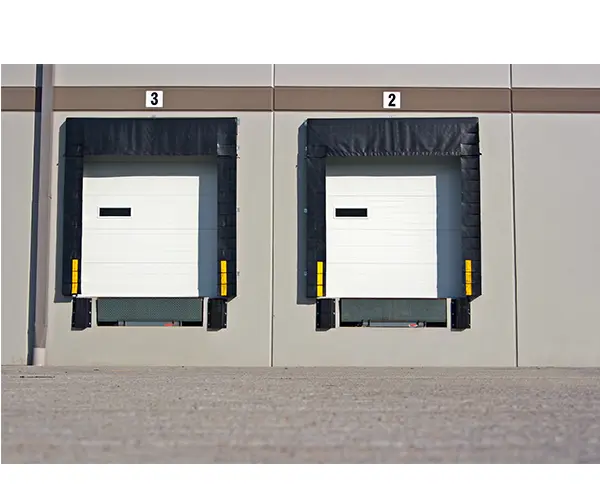
Dock shelters seal the gap between the building and the back of the vehicle while it is being loaded. In the UAE that matters for three reasons: they keep cooled air in and summer heat out, they reduce sand and dust entering the building, and they protect goods and staff from sun and the occasional rain. Curtain-type shelters suit mixed vehicle sizes. Cushion and inflatable shelters give a tighter seal and are common on temperature-controlled docks.
Loading dock houses
Loading dock houses are self-contained enclosures fixed to the outside of the building, with the leveller and shelter built in. They are used when there is no room inside for a leveller pit, when the full internal floor is needed for storage, or when the thermal envelope of a cold store should stay unbroken. They can also be set at an angle where the yard is too tight for vehicles to reverse square to the wall.
Mobile loading ramps
Where there is no raised dock at all, mobile loading ramps let a forklift drive from ground level into a container or trailer. They are moved into position when a vehicle arrives and taken away afterwards, so they suit sites with occasional container traffic, temporary facilities and yards that serve several loading points with one ramp.
Material handling scissor lifts
Material handling scissor lifts, or lift tables, raise and lower goods between two levels, for example from yard level to dock height or between a production line and a mezzanine. Specify the load, the platform size, the travel height and how often the lift will cycle each day.
What UAE conditions change
- Heat and conditioned space. Every unsealed dock door is an energy cost. Shelters and insulated doors pay back fastest on air-conditioned and cold-chain buildings.
- Sand, dust and coastal air. Ask about the protective finish on steelwork and about seals on hydraulic and electrical components.
- Mixed fleets. Many UAE warehouses receive everything from pickup trucks to 40-foot trailers at the same doors. Give the supplier the real vehicle list.
- Servicing. Dock equipment is safety equipment. Plan periodic inspection of hydraulics, lips, hinges and safety devices from day one.
Frequently asked questions
How do loading dock levellers work?
The platform rises, the lip extends, and the platform lowers until the lip rests on the vehicle bed. The leveller then floats with the vehicle as its suspension moves during loading. When loading ends the platform returns to dock level.
Do I need a dock shelter if I already have a sectional door?
The door closes the opening when no vehicle is present. The shelter seals around the vehicle while the door is open. On conditioned buildings the two work together.
Can dock equipment be added to an existing warehouse?
Often, yes. Mini dock levellers, dock houses and mobile ramps are the usual options when cutting a new pit is not practical.
Vulcan supplies loading and docking equipment under the Miacasa brand. See the Miacasa loading and security products page for the range, and our guide to industrial sectional doors and cold room doors for the door side of the dock.
Talk to Vulcan about your project
Planning a new dock or upgrading an existing one? Send us your requirement with the opening sizes, drawings or a door schedule, and our team will come back with a suitable configuration and quotation. You can also call +971 6 743 6665 or WhatsApp +971 55 608 8487.

